


The brain has been studied for many years, but it’s only in the last twenty that we have found out that it is constantly changing and developing. Our environment and lifestyle choices shape the health of our brain, with both trauma and nutrition playing a hugely important role. The brain is highly complex, with over 80 billion neurons and each of those neurons has thousands of synaptic connections. These are dynamic and ever changing, and so we must ensure that from conception it has what it needs to thrive.
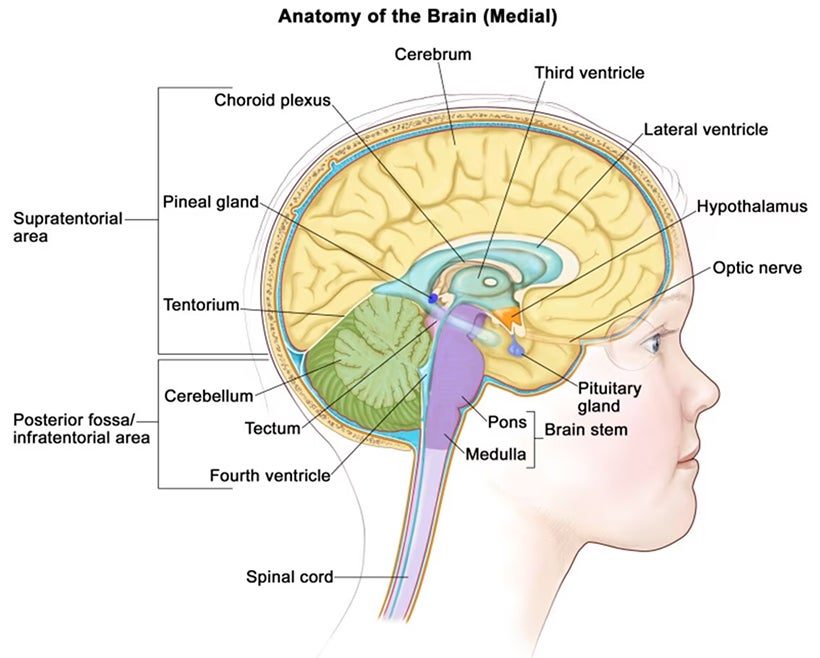
The structure of the brain
Human brain development starts shortly after conception, in the third week of gestation. Taking care of
our brains early and getting things right can have life-long payoffs. By week nine it has a smooth
texture and over the course of pregnancy its shape changes to the characteristic pattern of gyral and
sulcal folding. These cellular changes are a reflection of the needs these regions have, starting with
the neocortex, which is responsible for conscious thought, language, spatial reasoning and
sight.
It’s at this stage we start to differentiate between grey and white matter. The hindbrain and spinal
column, cerebellum, midbrain structures, deep subcortical nuclei and the neocortex are regions where the
cell bodies of neurons are grey in appearance, hence the name; grey matter. While the dendritic and
axonal parts form fibre pathways of neural networks that are white in appearance, hence the name white
matter. It’s also worth mentioning that what we know as grey and white matter only has this colour after
the tissue has been removed and prepared in a certain way. The myelination of the axons will have a
defining role in the speed and efficient transmission of signals between neurons. An immature white
matter structure may lead to learning difficulties. Across childhood, the structure of the brain
changes; white matter increases in late childhood and adolescence, while grey matter decreases.
Stages of brain development
The first 1,000 days are considered crucial in physical, cognitive, social, emotional and behavioural
development. Exposure to toxins, stress or poor nutrition may have a negative impact on the building
blocks of the brain’s foundation.
Gestation: Neurons and connections grow, cells begin to divide and
differentiate into neurons and glia;
the two types that form the basis of the nervous system.
Birth to 6 years old: Socialisation, cognitive, motor, communication and
emotional development is the
focus. Voluntary movement, reasoning, attachments, planning, working memory and perception can be
observed. Some call it a ‘sense of self’.
7 to 22 years old: The grey matter neural connections continue to develop, but
the white matter starts
to increase, in order to establish faster connections. The prefrontal cortex is the very last to mature,
which is observed through self-control and decision making.
The key brain nutrients
Nutrition has a fundamental role in brain development and in an ideal world, we would be screening women for nutrient deficiencies during child-bearing years to provide children the best possible start to life. The brain thrives on food diversity and consequently needs a large amount of different nutrients. Naturally, the spotlight is on a specific group of nutrients that are known to play a key role on brain development, from gestation to the adolescent years.
Protein
Protein restriction may lead to smaller brains with reduced RNA and DNA, less neurons, immature dendritic and synaptic connections, reduced neurotransmitters and less growth factors.
Omega-3 Fatty Acids
A 2016 global survey found that levels of EPA and DHA in most countries and regions are considered low to very low. Over 60% of the brain is made up of fat, while DHA makes up over 90% of the n-3 PUFAs in the brain and 10%–20% of its total lipids. It’s accumulation in the foetal brain increases during the last trimester of pregnancy and peaks in the early years. The impact of supplementation during gestation but also throughout childhood, has shown improved cognition and focused attention, a profoundly positive effect on neurotransmitters and mental health. It can also decrease neurodevelopmental disorders, lower rates of allergies and other atopic conditions and finally improve respiratory health. Some research also indicates it can improve sleep quality and duration. With this in mind, a high-quality Omega-3 supplement may be necessary during childhood. It’s important noting that DHA is highly concentrated in the grey matter, while the white matter is EPA dominant. Therefore, the right ratio must be considered when supplementing, to best support brain development.
Choline
A nutrient that deserves centre stage and plays a critical role in many biochemical reactions, including cell signalling and maintaining optimal health of cell membranes. It works alongside folate to support metabolic pathways and can act as a methyl donor, becoming integral for DNA repair, protein function and metabolism. In the brain, choline is essential for the formation of acetylcholine, a protein that carries signals between neurons and has been shown to improve memory.
Iron
A vast number of studies show the key role iron plays in overall health but especially brain development. In the brain, haemoproteins and non-haem enzymes rely on iron for their activity. It is also essential for the anatomic development of the brain, neurotransmitters and myelination. A group of children in Nepal, whose mothers had received iron supplementation showed better scores in cognitive and motor skills. It is interesting to point out that adequate iron during gestation meant the children did not have to receive supplementation during 12-35 months and the ones who did receive supplementation, did not show any improvement in their cognitive or motor skills.
Zinc
The jury is still out on the exact effect Zinc may have on children's cognition, but individual studies have shown that it is necessary for optimal neurogenesis, myelination, synaptogenesis and neurotransmitter regulation. A Zinc deficiency may lead to learning difficulties, mood disorders, poor attention and memory.
Iodine
Essential for the brain and its role in supporting thyroid hormones. A
deficiency in Iodine may lead to poor neurogenesis and glutamatergic signalling, as well as low
brain weight. Learning difficulties have also been observed in children. The foetal brain can be
particularly affected by an iodine deficiency during the first trimester of gestation, as it’s T3
production is completely dependent on the mother’s supply of T4.
There are over 45 nutrients that are essential for optimal brain health and development, many of
which have not been mentioned here, such as vitamin A, D, B6, B12 and Folate. A baby’s brain is
growing at light speed and remodels throughout childhood. Nutrition has the power to shape that for
life.